Understand why projects struggle before they begin and how missing foundations can limit successful delivery
Learn how readiness assessments determine whether a project is position for effective management and execution
Discover how a structured assessment helps identify gaps, clarify accountability, and prepare projects for success
Explore the four foundational areas that determine whether a project is ready to move from planning into delivery
Learn how a simple maturity – based scoring approach provides a consistent way to evaluate project readiness
Before assigning a project manager, assess whether your project has the foundation needed to success
Why Most Projects Aren’t Ready for Project Management (And What to Do About It)
In many organizations, project managers are brought in with the expectation that they will “fix” a project. The assumption is simple: if a project is struggling—or even just starting—a project manager (PM) will bring structure, clarity, and success.
But here’s the truth most teams learn the hard way:
- Project management cannot compensate for a lack of project readiness.
- In fact, when a project starts without the right foundations in place, assigning a PM too early can slow things down, create frustration, and lead to poor outcomes for everyone involved.
This is where a Project Readiness Assessment becomes essential.
What Is Project Readiness?
Project readiness is the degree to which a project has the basic conditions in place to be successfully managed and delivered.
It answers a simple but critical question:
- “Is this project ready for a project manager to lead it effectively?”
- A readiness assessment doesn’t evaluate whether a project is a good idea. Instead, it evaluates whether the project is structured enough to begin execution.
Why Projects Often Fail Before They Begin
Across organizations, especially in complex environments like healthcare, we consistently see projects struggle because foundational elements are missing:
- Objectives are vague or constantly shifting
- Stakeholders are not aligned
- Teams are over capacity
- Risks are unknown or ignored
- No clear ownership exists
In these situations, the PM ends up doing one of two things:
- Acting as a facilitator/consultant, helping define the project (not managing it)
- Trying to manage execution while simultaneously building the foundation
Both scenarios are inefficient and increase the risk of project failure.
The Role of a Project Readiness Assessment Tool
A well-designed readiness tool helps answer:
- Is the project clearly defined and scoped?
- Are stakeholders aligned and engaged?
- Does the team have the capability and capacity to deliver?
- Are risks understood and manageable?
It creates a structured, repeatable way to assess whether a PM should:
✅ Take full ownership of the project
⚠️ Provide coaching support only
❌ Decline PM involvement until readiness improves

The Four Pillars of Project Readiness
Your assessment tool is structured around four key domains. Each represents a foundational requirement for successful project execution.
1. Project Readiness
This pillar focuses on whether the project itself is clearly defined.
Key Elements:
- Objectives clearly defined
The project has clear, measurable goals. - Scope & deliverables understood
There is agreement on what is included—and what is not. - Roles & responsibilities clear
Everyone knows who is responsible for what.
- Resources allocated
The team, budget, and tools are available. - Dependencies & constraints identified
External factors and limitations are known.
Why It Matters
Without this foundation, a PM spends most of their time clarifying basics instead of managing progress.
2. Stakeholder Engagement
Projects do not fail because of tasks—they fail because of people and alignment.
KEY ELEMENTS
- Stakeholders identified and mapped
- Stakeholders engaged in planning
- Communication plan in place and active
- Expectations aligned
- Executive sponsorship active
WHY IT MATTERS
ven a well-scoped project will fail if stakeholders:
- Disagree on goals
- Are not engaged
- Do not support the work
Executive sponsorship, in particular, is often the difference between momentum and stagnation.
3. Team Capability
Even the best plan will fail without the right people.
KEY ELEMENTS
- Team skills match requirements
- Team understands objectives and deliverables
- Team has relevant experience
- Collaboration is effective
- Workload is realistic
WHY IT MATTERS
A project team must not only be capable—but also:
- Available
- Aligned
- Able to work together effectively
Projects frequently fail due to overcommitted teams, not lack of effort.
4. Risk Management
Every project has uncertainty—but unmanaged risk leads to predictable failure.
KEY ELEMENTS
- Risks identified and documented
- Mitigation strategies defined
- Risk monitoring in place
- Contingency resources allocated
- Lessons learned applied
WHY IT MATTERS
Projects don’t fail because risks exist.
They fail because risks are:
- Ignored
- Underestimated
- Not proactively managed
How Scoring Works (And Why It’s Simple by Design)
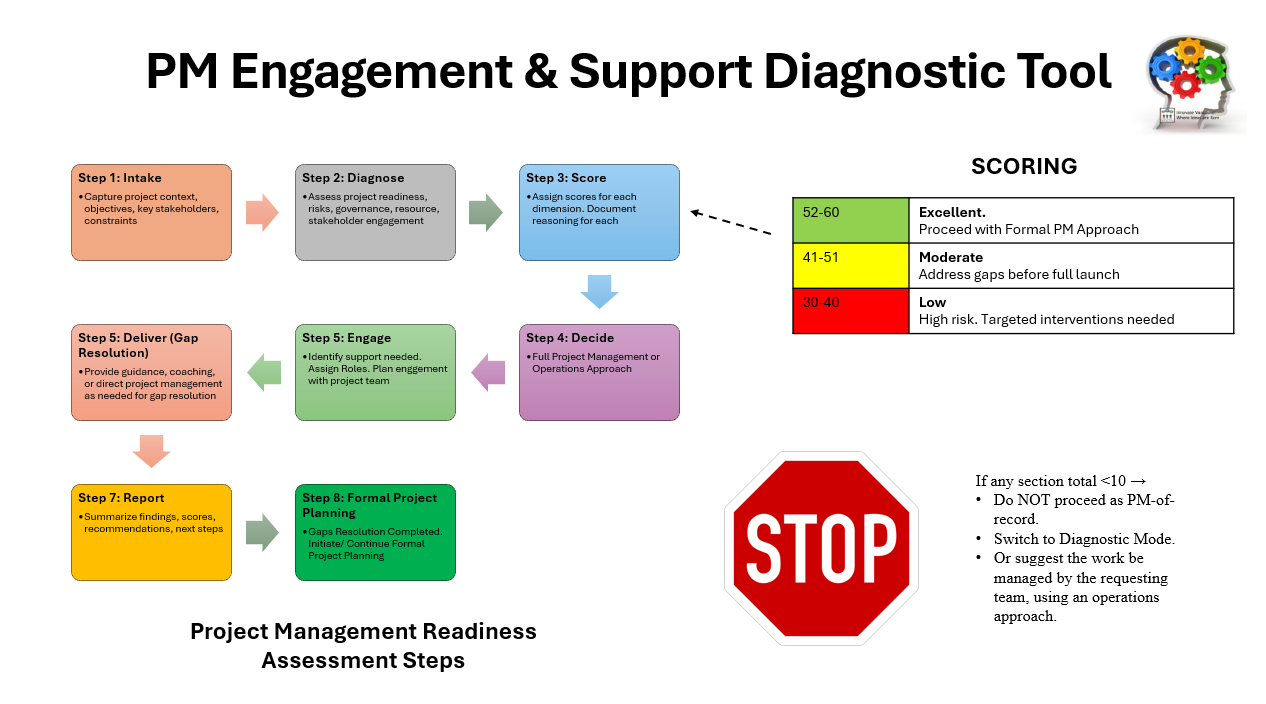
Each criterion is scored using a simple maturity model:
- 1 – Low readiness
- 2 – Partial readiness
- 3 – Fully ready
This structure keeps the tool:
- Easy to use
- Fast to complete
- Consistent across teams
Each section has a total possible score of 15.
The Critical Threshold: When a PM Should Not Take the Project
A key rule in your model is:
If any section scores below 10, the PM should not take on a formal PM role.
This is not about being restrictive—it’s about being responsible.
When a section scores low:
- The project is not ready for execution
- Assigning a PM will not fix the underlying gaps
Instead, the PM can:
- Provide coaching
- Help define missing elements
- Support readiness development
Only once the project reaches baseline readiness should full PM engagement begin.
What This Approach Changes in Practice
Implementing a readiness tool shifts how organizations operate:
BEFORE
- PMs assigned too early
- Projects start with unclear direction
- High rework and frustration
AFTER
- Projects must meet minimum readiness
- Stakeholders take accountability earlier
- PMs focus on delivery—not cleanup
Common Pushback (And How to Address It)
“We need a PM to figure this out.”
→ What you actually need is project definition support, not delivery management.
“This will slow us down.”
→ Starting unprepared slows you down far more.
“We don’t have time for this.”
→ Then you likely don’t have time for delays, rework, or failed delivery either.
Selecting an Appropriate Governance Approach
The goal of a readiness assessment is not simply determining whether a project should proceed. It should also help identify the level of governance needed to maximize the likelihood of success.
Organizations often default to a single PMO model regardless of project complexity. While this may simplify administration, it can create unnecessary overhead on low-risk initiatives or insufficient governance for strategic programs.
Rather than asking “What type of PMO do we have?”, organizations should ask: “What level of governance best supports this project’s successful delivery?”
- How much uncertainty?
- How many stakeholders?
- How much organizational change?
- How much governance is required?
- What happens if project fails?
Different Project Management Office (PMO) Governance – Types
| Supporting PMO | Provides guidance, tools, templates, and best practices while allowing project teams flexibility in how they deliver. | Enable success |
| Controlling PMO | Establishes standards, governance, and oversight to ensure projects comply with organizational policies and reporting requirements. | Ensure consistency |
| Directing PMO | Directly manages projects by assigning project managers, governing delivery, and aligning initiatives to strategic objectives. | Deliver strategy |
Heuristic for Selecting PMO/ Project Management – Governance Support Needs
| Project Characteristic | Supporting | Controlling | Directing |
| Small Team | ✓ | | |
| Innovation | ✓ | | |
| Experienced PM | ✓ | | |
| Cross-functional | | ✓ | |
| Multiple vendors | | ✓ | |
| Regulatory | | ✓ | ✓ |
| Enterprise | | | ✓ |
| Executive visibility | | | ✓ |
| Large budget | | | ✓ |
| Organizational change | | ✓ | ✓ |
Project success depends less on adopting a particular PMO model than on selecting governance that is proportional to the project’s complexity, risk, and strategic importance.
Not every initiative requires a formal project management methodology. For lower-complexity efforts, an operational approach may provide sufficient structure and oversight.
However, when project risks, scope, dependencies, and complexity require more formal governance, resources and leadership must be aligned on what is required to successfully adopt and sustain a project management approach. This includes the necessary roles, decision-making structures, processes, tools, and organizational support.
A project manager should not be formally committed to leading a project through a structured delivery approach until the foundational capabilities required for success are in place.
Final Thought: Readiness Is Shared Responsibility
A project readiness assessment is not a gatekeeping tool.
It is a shared accountability framework between:
- Sponsors
- Teams
- Stakeholders
- Project managers
It ensures that when a PM is assigned, they are positioned to lead—not rescue.
Call to Action
Before assigning a PM to your next project, ask:
“Are we truly ready—or are we asking the PM to build the runway while flying the plane?”
If the answer is unclear, it’s time to apply a structured readiness assessment.
Travis Barker, MPA GCPM
Innovate Vancouver
Innovate Vancouver is a Technology and Business Innovation Consulting Service located in Vancouver, BC. Contact us to help with your next project!